Order Flow Platform for Indian Markets

Order Flow Trading for Indian Markets

Stop reading candles and start reading the tape. VolumeLens shows you exactly where aggressive buyers and sellers hit the book — at every price level, on NSE stocks and index futures and options. See who initiated the trading, not just where price closed.

~2,000 NSE stocks plus NIFTY, BANKNIFTY, FINNIFTY, MIDCPNIFTY and SENSEX futures and options. No separate data subscription. Last reviewed: 16 Sep 2026.

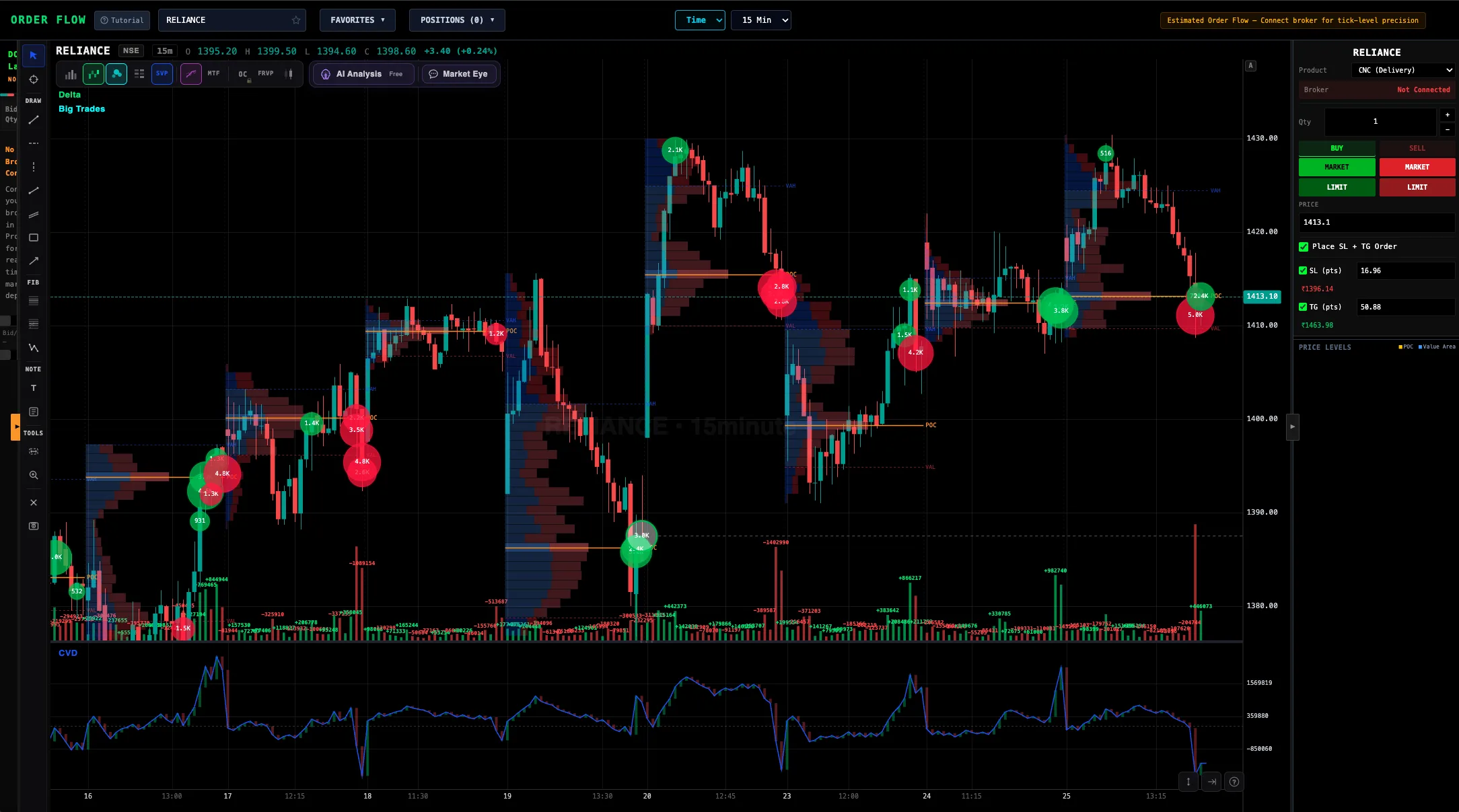
VolumeLens order flow dashboard

What is order flow trading?

Order flow is the microstructure underneath the candle. A candle tells you the stock went from ₹2,450 to ₹2,465 on 3 lakh volume. That's it. It doesn't tell you whether buyers were aggressively lifting offers, or whether sellers just stopped pressing and the price drifted up on low volume.

Those two scenarios look identical on a candlestick chart. On an order flow chart they look completely different: one shows buyers lifting offers at every level, the other shows almost no initiative at all.

Order flow has been the standard for proprietary futures traders in the US and Europe for 15+ years. It is how funds at CME and Eurex make decisions. For Indian retail traders, it has been effectively unavailable — global platforms didn't support NSE data, or needed a separately licensed data feed billed in dollars. VolumeLens builds these tools for Indian instruments directly.

The four order flow tools every Indian trader needs

Footprint Chart

Bid vs ask inside every candle

Each candle shows exact buy volume vs sell volume at every price level. Imbalances (3:1 or more one-sided) are auto-highlighted. See exhaustion at tops and absorption at bottoms.

DOM Ladder

Live market depth with resting liquidity

The best bids and offers with quantities, updating live. See where resting size sits and how it changes as prices trade. Place orders from the ladder with a connected broker account.

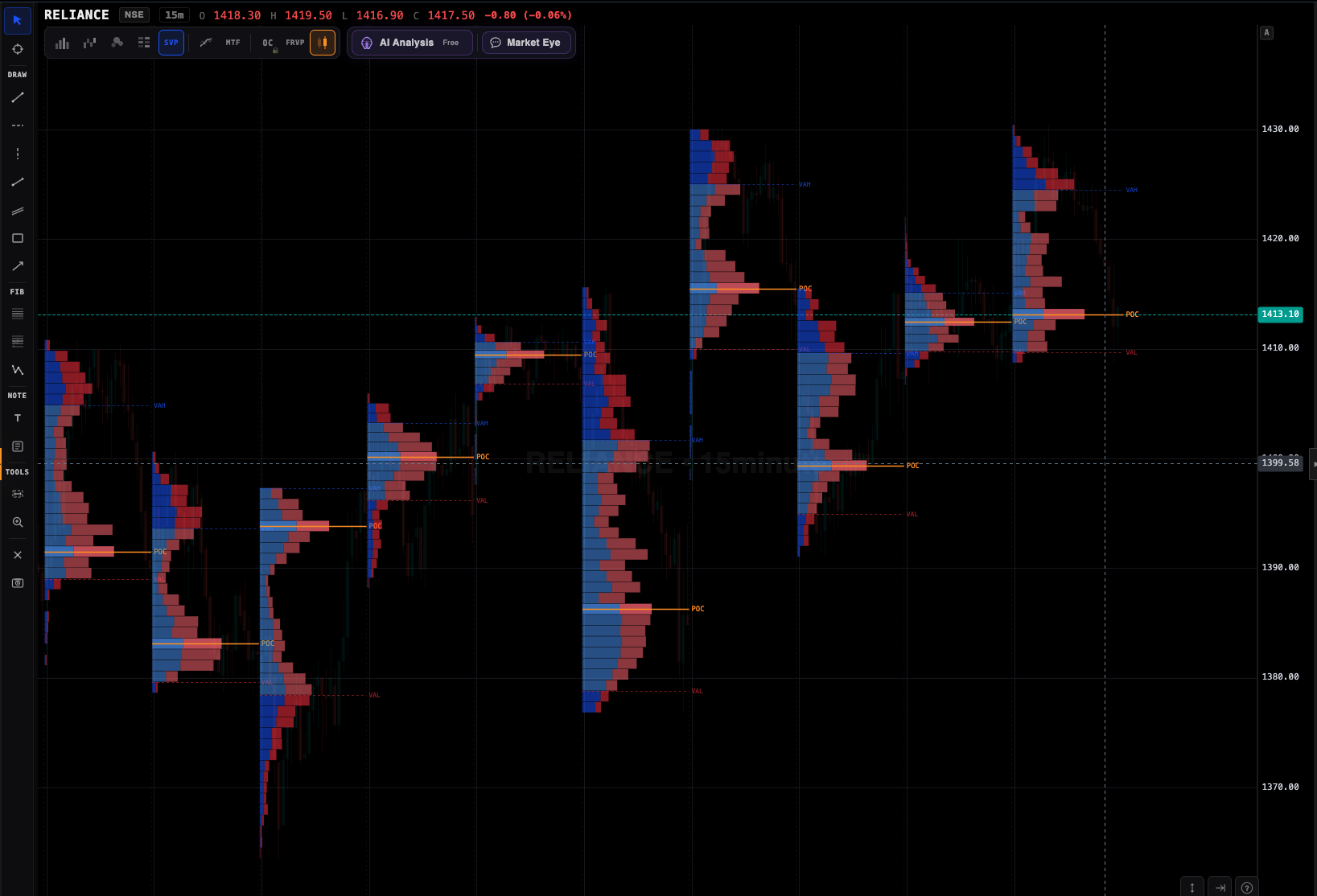
Volume Profile

Where the real volume happened

Session volume profile and fixed range volume profile (FRVP). Point of Control (POC), Value Area High/Low, high- and low-volume nodes. See which prices the session actually traded, not just where it went.

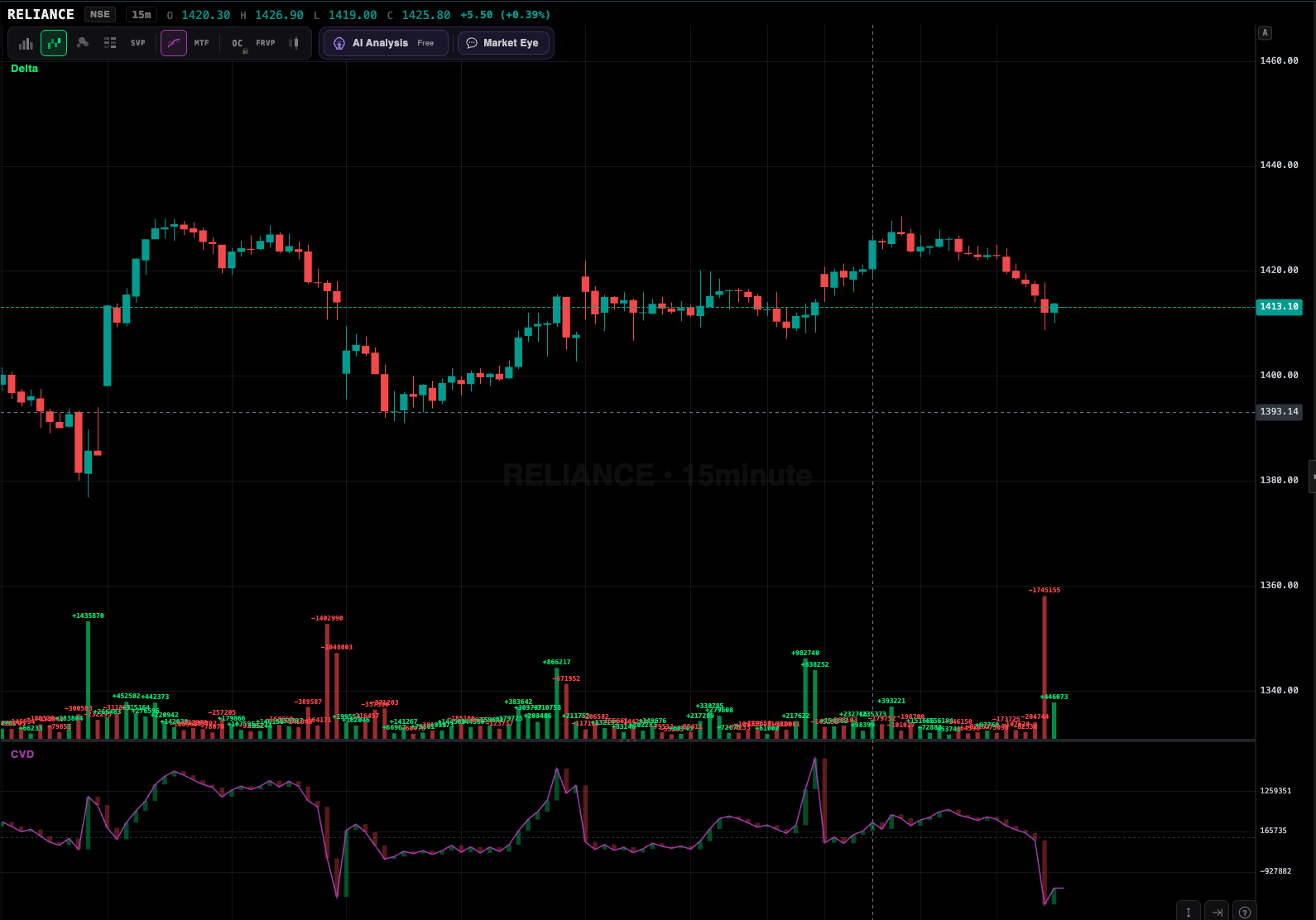
Cumulative Volume Delta

The real-time buy-sell scorecard

Running total of aggressive buy minus sell volume, reset each session. When price and CVD disagree, the chart and the tape are telling different stories — CVD makes that visible on NSE charts.

Cumulative Volume Delta chart

Why order flow matters for Indian traders specifically

Indian markets have their own structure. Liquidity outside the large caps is thin, so a handful of orders can move a mid-cap stock. Index options expiries concentrate enormous volume into a few hours. Index futures carry heavy algorithmic activity. In all three, the candle alone hides who is actually trading.

Order flow makes that participation visible. When RELIANCE pushes above a 5-minute high but the footprint shows the push printed on light buy aggression while a resting seller absorbed volume at the high, the candle and the tape disagree. When BANKNIFTY futures fall while CVD stays flat, the decline is happening without net aggressive selling. Neither observation predicts the next candle — both describe the move more completely than price alone.

A candle is four numbers. A footprint is every price inside it. Order flow does not forecast price. It shows who initiated the trading that produced the candle — the part a price chart cannot show.

What the order flow tools make visible

Candle chart vs order flow: what each shows

SituationWhat a candle chart showsWhat order flow adds
Breakout at resistanceA close above the levelWhether the breakout candle printed on strong or weak buy aggression
Gap-up openThe size of the gapWhether the first minutes of CVD build with the gap or against it
Support retestPrice touching the levelWhether sell aggression at the level is being absorbed
Expiry day chopOverlapping candlesWhere the session's volume concentrated on the volume profile
Large block printOne tall volume barThe price, size and side of the large trade

How VolumeLens Order Flow works under the hood

Order flow needs trade-level data, which is what makes it hard to build. VolumeLens processes the live NSE market feed server-side: each trade is classified as buyer- or seller-initiated against the best bid and offer, then aggregated into footprint cells, per-candle delta, CVD, large-trade markers and volume profiles. Order flow for roughly 2,000 NSE stocks and the major index futures and options needs no separate data subscription; stock futures and options use your connected broker account.

The source is a streaming market feed, which samples trades rather than recording every single exchange print. That is why VolumeLens order flow is built for reading direction, levels and imbalance — where volume traded and which side initiated it — rather than exact exchange volume counts.

Session volume profile with POC and value area

Order flow plus everything else

Order Flow is the moat, but VolumeLens is a full platform. The same interface gives you:

Frequently asked questions

What is order flow trading?

Analysing live buy/sell orders at every price level to understand who is aggressive. It reveals what candlestick charts hide: whether moves are backed by real conviction or are weak drift.

Is order flow available for Indian stocks and indices?

Yes. VolumeLens provides footprint charts, delta, CVD, large-trade detection and volume profile for roughly 2,000 NSE stocks and for index futures and options including NIFTY, BANKNIFTY, FINNIFTY, MIDCPNIFTY and SENSEX. Stock futures and options need a connected broker account.

Do I need extra data fees?

No. Order flow for NSE stocks and index derivatives is included — you do not buy a separate market data subscription. Pricing is pay-per-use coins; see pricing.

How live is the data?

Charts update continuously from the live market feed during NSE trading hours. The feed is streamed rather than exchange tick-by-tick, so it is built for intraday chart reading, not latency-sensitive high-frequency trading.

What is CVD?

Cumulative Volume Delta — the running sum of aggressive buys minus aggressive sells, reset each session. When price and CVD disagree it is called a divergence. See CVD explained.

Can I trade from the DOM ladder?

Yes, with a connected broker account. Click a price level on the ladder to place a limit order on your linked Zerodha or Groww account.

Does order flow work on smaller mid-cap stocks?

Yes, but liquidity matters. For stocks with less than ₹10 crore daily turnover, the footprint becomes sparse and less statistically meaningful. Order flow shines on liquid names — Nifty 500 equity and NFO index futures.

Do I need coding?

No. Everything is visual. Footprint imbalances are highlighted on the chart, large trades are marked, and the AI Mentor and Market Eye describe absorption, divergence and imbalance events in plain language.
Free daily order-flow data for 450 NSE stocks

Every trading day, VolumeLens publishes the order-flow numbers for each Nifty-500 stock — net delta, large-trade buy/sell split, and the highest-volume price level — alongside price, delivery percentage and 52-week position. A few examples:

Browse all 450 NSE stock data pages → · Daily screeners → · Compare order flow platforms & software in India →

See the market the way institutions do

Footprint, DOM, volume profile, CVD — the tools futures traders use worldwide, built for NSE stocks and Indian index derivatives.

Keep learning: order flow explained

Longer-form explainers on the concepts behind these tools — what each chart measures, and what it cannot tell you.

All 23 explainers in the Learn hub →