Minervini Trend Template for India

SEPA Scanner for NSE and BSE Stocks

Mark Minervini's 8-criteria trend template — adapted for Indian markets. Find stage 2 leaders on NSE and BSE in one click. RS rating benchmarked against Nifty 50 and Nifty 500. No formulas to write, no manual checking.

Updated daily after market close. NSE + BSE universe. RS ranked 1-99.

What SEPA is and why it works

SEPA — Specific Entry Point Analysis — is the methodology Mark Minervini developed while winning the US Investing Championship twice (1997 and subsequent years). It's simple in principle: buy stocks that are already in confirmed stage 2 uptrends, have strong relative strength, and are within striking distance of new highs. Ignore everything else.

The trend template is the filter that defines "stage 2 uptrend". It's 8 specific criteria that together ensure you're looking at a stock that has made the transition from basing (stage 1) into sustained advance (stage 2) and hasn't yet topped (stage 3).

The statistical case is strong: historically, 90%+ of big winners in US markets satisfied the trend template before their major move. The same pattern holds in Indian markets — the big winners of 2020-2024 (Adani Enterprises, Trent, TataMotors, Zomato post-IPO recovery) all passed the template at the start of their runs.

The 8 SEPA criteria

  1. Price above 150-day and 200-day moving average. The stock is in a long-term uptrend.
  2. 150-day MA above 200-day MA. Intermediate trend confirms the long-term trend.
  3. 200-day MA trending up for at least 1 month. Not a sideways base masquerading as an uptrend.
  4. 50-day MA above both 150-day and 200-day MAs. Short-term momentum is aligned with medium and long-term.
  5. Price above 50-day MA. Current price is in control of the shorter moving average.
  6. Price at least 30% above 52-week low. The stock has already started moving — not buying the low.
  7. Price within 25% of 52-week high. Still has room but is a genuine leader, not a laggard.
  8. Relative strength rating above 70 (on 1-99 scale, benchmarked against Nifty 500).

A stock must satisfy all 8 to qualify. This is deliberately strict — you want the cream, not the marginal cases.

SEPA scanner results on NSE stocks

How VolumeLens implements SEPA for India

RS rating benchmarked to Indian indices

In the US, RS is computed against the S&P 500. In India, the right benchmark is Nifty 500 (or Nifty 50 for large-cap leaders only). VolumeLens computes a custom 1-99 RS rating daily for every NSE and BSE stock using a weighted formula: 40% weight on 3-month price change vs Nifty, 20% on 6-month, 20% on 9-month, 20% on 12-month. This matches the IBD methodology Minervini uses.

Sector-adjusted view

The raw SEPA list often gets heavy in one hot sector. VolumeLens also shows sector-relative RS — the stock's rank within its sector — so you can diversify your picks instead of buying 5 defence stocks simultaneously.

Volume and liquidity filter

Indian mid and small caps can pass SEPA technicals while being too thinly traded for safe position sizing. VolumeLens adds a turnover filter (default ₹10 crore/day) to ensure every SEPA candidate is actually executable at retail size.

Earnings proximity warning

SEPA signals that fire 2 days before results are dangerous — you can get stopped out by a results gap regardless of the technical setup. VolumeLens flags candidates with earnings in the next 5 sessions so you can skip or size down.

From SEPA list to actual trade

The SEPA list is just step 1. Most traders stop there and then wonder why they underperform. Minervini's own entry is far more specific — the VCP (Volatility Contraction Pattern) breakout from a proper base. VolumeLens helps with step 2-4 as well:

Step 2: Find the base

Chart each SEPA candidate. Look for consolidation after the recent advance — a 3-8 week sideways range where volatility is contracting (ATR shrinking, range narrowing). The tighter the base, the higher quality the setup.

Step 3: Time the entry

Buy the breakout from the base on volume. Ideally 2x+ average volume on the breakout bar. Stop goes below the last pivot low inside the base (usually 5-8% below entry).

Step 4: Manage with trailing

Once in, set up an automated trailing stop in VolumeLens (2x ATR or swing-low based). Move to breakeven at 1R. Scale out at 2R and 4R if desired. Let the rest ride.

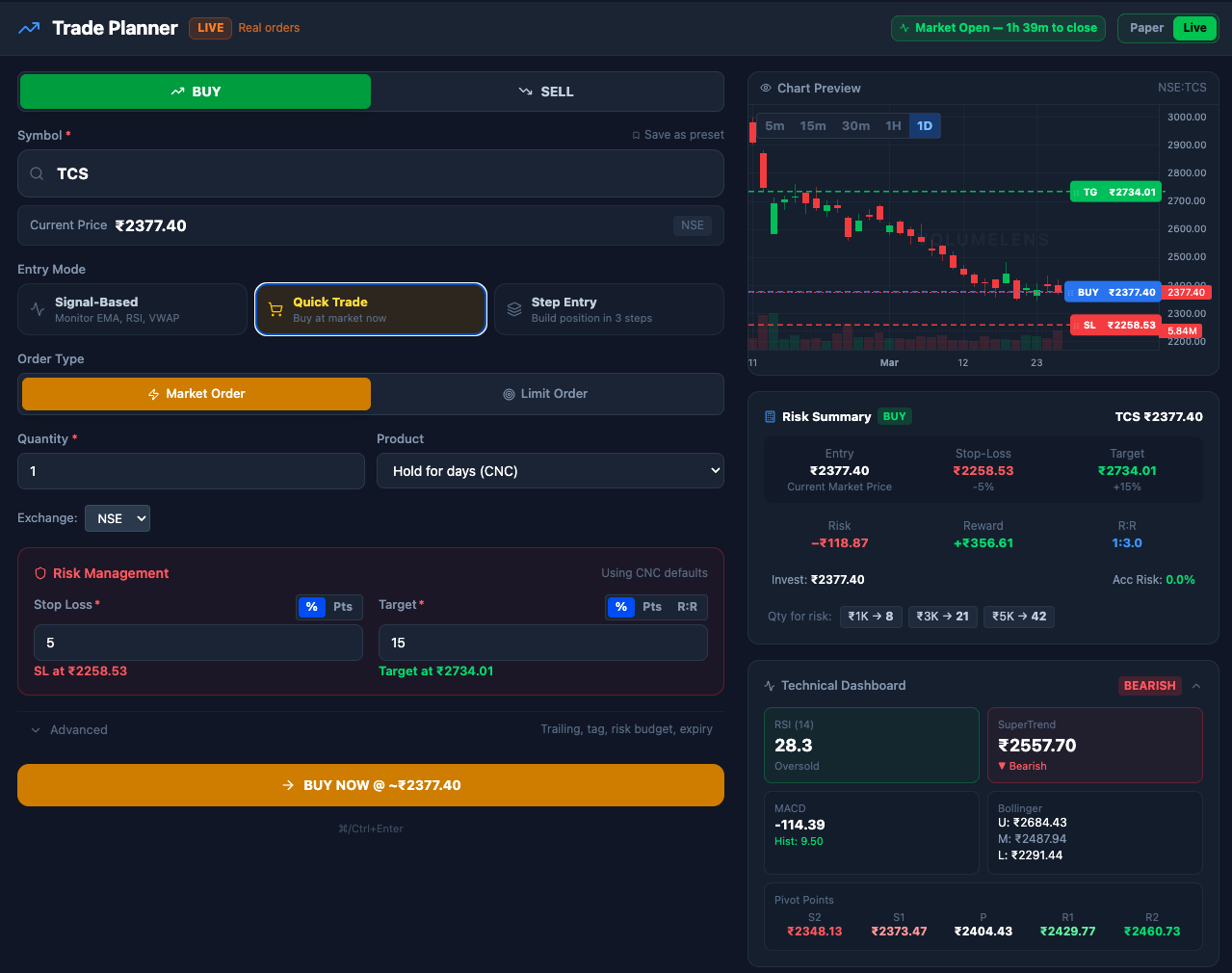
Trade planner with SEPA stock setup

Real SEPA performance in Indian markets

~150Avg stocks on SEPA list
12%Avg 6-mo return (backtest)
58%Hit rate at 2R stop
<3sScan execution time

Backtest caveats: results are based on 2018-2024 NSE data with a simple 2R exit rule. Actual live results depend heavily on base selection, entry timing, and position sizing — SEPA is the top-of-funnel filter, not a complete system.

The purpose of SEPA is not to give you a buy list — it's to eliminate 95% of stocks from consideration so you can focus your time on the leaders. An average SEPA list on Indian markets has 100-200 stocks. Your job is to find the 5 best bases within that list.

Customising SEPA for your style

Strict SEPA

All 8 criteria, price within 15% of high, RS > 85. Yields ~30-50 ultra-leaders. Best for concentrated portfolios.

Standard SEPA

Default 8 criteria, RS > 70. Yields ~100-200 candidates. Good for diversified swing trading.

Early SEPA

Relax price-above-high filter to 40%. Yields ~250-400 names. Catches earlier-stage breakouts.

Sector SEPA

Run SEPA within a specific sector. Useful when you have a macro thesis (e.g. "defence sector leadership").

Frequently asked questions

What is SEPA?

Specific Entry Point Analysis — Mark Minervini's methodology for finding stage 2 uptrending leaders. The 8-criteria trend template is its filter.

Does SEPA work in Indian markets?

Yes. The trend template works anywhere with liquid equity markets. For India, we benchmark RS against Nifty 500 instead of S&P 500.

What are the 8 criteria?

Price above 150 and 200 MA, 150 MA above 200 MA, 200 MA uptrending, 50 MA above 150 and 200, price above 50 MA, price 30%+ above 52-week low, within 25% of 52-week high, RS rating 70+.

How often should I run it?

Daily is ideal — after market close or start of next session. Leaders don't change overnight, so weekly is also fine for most swing traders.

What is a good RS rating?

70+ qualifies under Minervini's rules. 80+ is solid, 90+ is strong leadership. Prefer 85+ when markets are extended.

Can I customise the criteria?

Yes. Tighten the "within X% of high" rule, raise the RS threshold, add a turnover minimum, restrict by sector or market cap.

Does SEPA work on small-cap Indian stocks?

Technically yes, but liquidity becomes a concern. We recommend a minimum daily turnover of ₹5 crore (₹10 crore for safer sizing) when filtering SEPA candidates.

What do I do after I have the SEPA list?

Find quality bases (3-8 week consolidations with contracting volatility), time the breakout with volume confirmation, set a proper stop, use automated trailing. The list is step 1 of 4.

Stop picking stocks at random

SEPA gives you the leaders. VolumeLens helps you trade them properly.